At 28 I Was Made Redundant in the Last Technology Boom


Author: Simon Rasalingham, 2026 In 2002, at twenty eight, I was made redundant. Guinness World Records had been carved out of Diageo and sold. I was out. I had a paid-for MBA, had never set up a company, and I had spent two years learning the latest dot com skills . Now I was redundant.
The dot-com bubble had truly burst for me.
I had a Porsche 911, a flat and no children and no income. One minute you are building a dot-com business. The next you are reading your own redundancy terms with the industry in flames.
I am writing this because a lot of people are currently worried about their own job and artificial intelligence. If you listen to the labs, every job is toast. Nobody is talking about a bubble this time. It is boom time - trillions.
There will be redundancies.
And redundancy feels like a scar, permanent, never fading.
The scar you are carrying is not the one they can see
There is an experiment from Dartmouth that I found inspiring. I came across it recently on an episode of How to be Awesome at Your Job with Suneel Gupta, whose book Backable opens with it. I went and read the original paper.
In 1980 two psychologists, Robert Kleck and Angelo Strenta, applied a realistic facial scar to volunteers with theatrical makeup and let each one see it in a mirror. The scar was then removed (they were told it was a touch-up) without the volunteer being shown a mirror again, so each one believed it was still there. They were sent into a conversation with a stranger who knew nothing about the theatrics.
The volunteers came out reporting they had been stared at, avoided, made uncomfortable. They had read rejection into behaviour that contained none.
It was twenty five students and a six minute conversation, a very small sample, but I suspect a lot of people reading this will still empathise with the feeling.
I recognised it immediately.
I walked into every meeting in 2002 convinced that being made redundant at twenty eight was written on my face.
Not one person I was selling to could see it. I trying to mask a scar, that I had put there myself, which is exactly what the Dartmouth volunteers were doing too.
The doctors were interested in me and what I was showing them, this new innovative dotcom technology that could be applied to the NHS. Not my past. But setbacks can make you feel like a failure. The research position on setbacks is not comforting. Gompers, Kovner, Lerner and Scharfstein studied nearly nine thousand venture backed founders. Those who had previously succeeded went on to succeed thirty per cent of the time. First timers, twenty one per cent. Those who had previously failed, twenty two.
However success buys you a great deal.
I made success out of my skills in the last bust. What about this one?
The dot-com bust destroyed companies, many of them online and many on our high streets too. It also created a set of founders who came out of the crash with the confidence to start something of their own.
I had a dot com technology skill set and was in the last year of my MBA, the NHS was starting to digitise. People who could move big files securely were suddenly were novel, and tele-radiology had barely begun. I was a beneficiary of a crash in valuations, not a crash in the value of what I knew.
The service I eventually built on top of that skill, Nighthawk, was still the most profitable thing I have operated twenty years later. Reports from labs like Anthropic show that, actually, those skills are being swallowed up. See Figure 2 in the link.
My own data points the other way.
A radiologist with AI beat the best radiologist without it
At behold.ai we spent a long time on which use cases were clinically relevant. One of the things I had learned at MEDICA was how much a lung cancer missed on a chest X-ray costs the patient. I later experienced that personally, after I had built the algorithm.
Dr Matt Tam, a consultant radiologist at Southend Hospital in the Mid and South Essex group, designed the test. Matt was an excellent person to work with because he wanted to give our algorithm a hard time.
He went through seven years of the hospital’s lung cancer registry and pulled 200 cancers, deliberately choosing the hard ones: small tumours, tumours at the apex, behind the heart, overlapping the hilum. Where an earlier X-ray showed the tumour in hindsight, he used that one.
He matched them with 200 X-rays from patients of a similar age with no significant finding.
We gave them to three consultant radiologists, each with at least twelve years in the NHS, who did not see the AI’s results. Then we ran our algorithm on the same set.
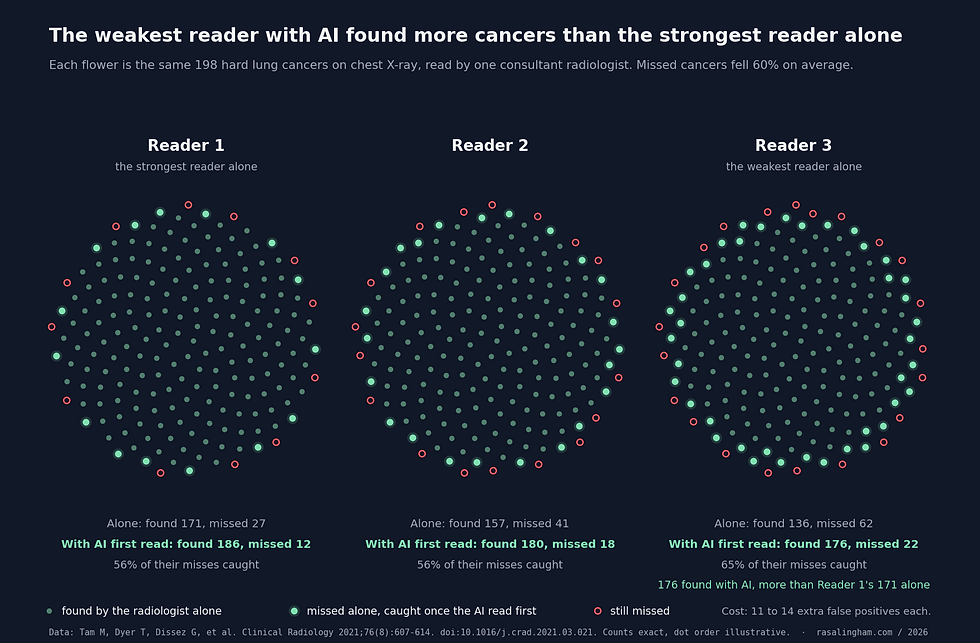
The first the test showed was how widely three experienced radiologists vary on a hard set of cases. Sensitivity ran from 69 to 86 per cent.
You would see the same spread in most professions given a difficult enough test.
On its own, the algorithm matched the average radiologist on accuracy, at 87 per cent.
The interesting part was what happened when we combined them.
We simulated the AI as first reader. Missed cancers fell by 60 per cent on average.
The lowest performing reader combined with the AI finished ahead of the best reader working alone. I will say that again: the lowest performer beat the best performer using our AI.
That is the combination I believe will define the next wave. Not redundancy.
A professional working with AI performing above the level of the best professional working without it.
With the constant stream of updated models at a very defined cadence, impossible without the use of AI we are seeing all ranges of engineers, together with AI, producing more work than they ever have done, and better models.
I used to call that superhuman. My radiologists told me off for using the word. I am using it anyway.
So integrate what you already know with AI.
Do not spend your energy worrying about the scar.
Three takeaways
1) The scar is invisible. Nobody in the meeting is thinking about your redundancy. Spend the attention on their problem instead of your own.
2) Audit what you have learned in this wave, not what you have survived. The evidence shows that integrating AI into your work is the best gain.
3) Learning through hardship is a skill, some people call it resilience. However the skill that compounds is a specific capability learned in your industry, that you can carry into the next opportunity, using new tools that are in your hands, now.
Scars heal. Most people never notice them.
We are living through the biggest wave of technology since the internet was created. Go be superhuman!
Author: Simon Rasalingham, 2026
Further reading
How the skill turned into a compounding product, in Nighthawk and the second product.
Why I later took money from a hospital network rather than a venture fund, in strategic investor or venture capital.
Sources
Tam M, et al. “Augmenting lung cancer diagnosis on chest radiographs: positioning artificial intelligence to improve radiologist performance.” Clinical Radiology, 2021;76(8):607-614. doi:10.1016/j.crad.2021.03.021
Kleck RE, Strenta A. “Perceptions of the impact of negatively valued physical characteristics on social interaction.” Journal of Personality and Social Psychology, 1980;39(5):861-873.
Gompers P, Kovner A, Lerner J, Scharfstein D. “Performance persistence in entrepreneurship.” Journal of Financial Economics, 2010;96(1):18-32.
Mockaitis P. “The 7 Steps to Winning Others’ Support with Suneel Gupta.” How to be Awesome at Your Job, episode 708, 2021.
Gupta S. Backable: The Surprising Truth Behind What Makes People Take a Chance on You. Hachette, 2021.


Comments