Strategic Investor or Venture Capital: the Right Deal for the Wrong Reasons

Updated: 6 days ago
How to Build a Start-up, Part 7, Author: Simon Rasalingham, 2026,
The email came first, then a phone call from one of the largest VCs in the States. It was 2007.
Venture capitalists I had never met, calling a reporting business in England to ask what we were building. My first reaction was, why are they calling me?
The call was not an offer. It was a temperature check.
Taking American venture money was not in my plan. My focus was the NHS. There were two very large US outfits doing what I was doing, both listed on NASDAQ, so I knew that if you could scale there was an enormous opportunity in front of you.
That is not why the call mattered.
For a long time my business partner and I had been having the same argument. Was this a real business, or a well-run service that happened to be busy? Two intelligent people can hold that disagreement for years without resolving it, because both of us were looking at the same numbers and reading them differently.
The calls settled it. Not because a venture capitalist is a good judge of a British radiology business, but because people who look at hundreds of companies a year, from four thousand miles away, had found us without being told to.
That is a market signal. It costs an analyst nothing to notice you and quite a lot to pick up the phone. When several of them do it unprompted, the thing you have built has started to show up in somebody else’s pattern recognition before it has shown up in yours.
I did not take their money. I did take the information. It gave me confidence I was travelling the right path.
Inbound interest tells you something is scaling. It tells you nothing about what you are worth
Unsolicited investor interest is evidence that your growth curve is visible from outside.
That is real and useful, particularly when you have been arguing with your own co-founder about whether it exists.
It is not evidence of your valuation, your readiness, or the quality of the investor. A call is a useful temperature check on where the outside thinks you are. Do not pass up the chance to take one if you get pinged.
I have written before about how a signed customer proves more than a funding round.
The same logic holds here. The call is an indicator and a partial validation of something your customers have already told you. You have something that has value.
There are more ways to fund scale than the two everyone names
Founders tend to frame this as venture capital or nothing. There are more options on the table.
You can grow on cash from customers. Slower, and it costs you no equity. I have made the case for building the cash flow before the model, and for most service businesses that is the right place to start.
You can borrow against contracted revenue. We factored our invoices, which is how a service business selling to the NHS manages cash at all. We could draw up to ninety per cent against an invoice the day it was raised rather than waiting out the payment terms.
Nobody writes about factoring because it is not very sophisticated.
For a business whose costs are people paid monthly and whose customer is an institution that always pays eventually, it is the cheapest growth capital available. Your customer’s credit quality is an asset sitting on your balance sheet. Most founders never think to borrow against it. As I have mentioned previously, the NHS might pay late, but it always pays. It is as good as sovereign debt.
You can take venture capital, which buys speed and brings pressure, expectation and a clock.
You can take private equity, which arrives later and wants a different shape of business.
Or you can take strategic investment. Money from a company inside your own market, usually a customer, a supplier or a distribution partner.
In my view that is the first thing to look for before VC.
We factored throughout, before investment came from the UK’s largest healthcare charity. The strategic investment sat on top of a working capital facility that was already doing the heavy lifting. That matters for how you read what follows. We were not raising to survive.
We were raising to reach a bigger network.
We took strategic investment from a hospital network
Nuffield Health invested in MEDICA. The project name for the deal was Jericho.
The logic was obvious to everyone in the room. We had a reporting service with real demand. They had a national network of hospitals and over 400 affliated Radiologists.
Put the two together and the service scales across their network and more Radiologists. We get volume. They get NHS customers from our network and a fast growing company.
I still think the logic was sound. A healthcare charity with a national estate is a very different investor from a venture capital group. It was the economics that did not work.
Stability is worth more than founders think. It is not the same as growth
Here is what the deal gave us. In hindsight, even though the economics did not work out, it was the right deal at that time.
A strategic investor who understands your market does not panic. They know what an NHS procurement cycle looks like. They know why a contract was delayed. They do not ask you to triple next year because a different portfolio company did. They had a long-term outlook.
That stability is worth real money when you are scaling an operation that depends on recruiting and retaining clinicians. It helped us hire against the curve, which was one of the limits of factoring: the money goes into the team out of free cash flow.
What it did not give us was the growth we had both expected from combining the networks.
Three things stopped it. In hindsigt all three were visible before I signed.
Their network did not need our engine
Our profit engine was Nighthawk. Part 6 is the whole story of how I created it.
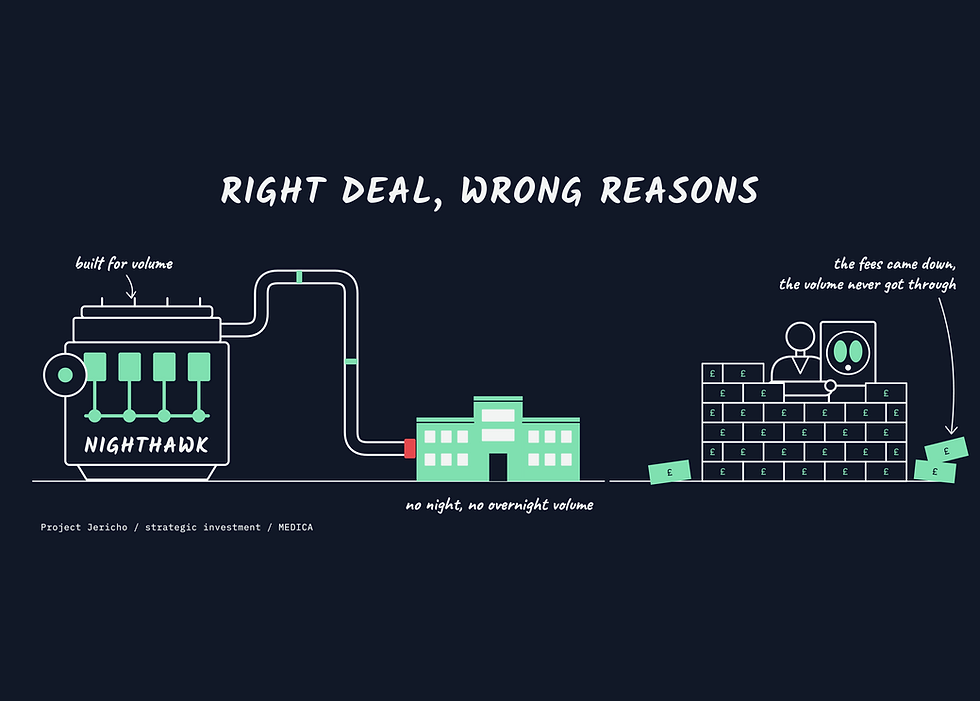
Nighthawk compounded because every hospital we added improved the economics of a radiologist’s night. It ran on overnight emergency and trauma volume. That demand exists in an NHS acute trust because the hospital has an A&E department and people arrive at three in the morning.
A private hospital does not have that. The work is elective, booked in advance, done in daylight. There is no night to cover.
Nor was there much plain film. Private hospitals do not generate the chest x-ray volume an acute trust does, so the product we had started the business with had almost nothing to feed on either.
What that estate had was cross-sectional imaging. CT and MRI. The highest value work in any radiology department.
So the compounding product had no demand to run on, and the core product that made the money had no volume. The reason why is the next section, and in hindsight it is the part I should have worked out first.
The only work worth having was the work the consultants guarded
The deal was signed at board level. The volume had to come from the sites.
At each site there were consultant radiologists reading the cross-sectional work privately. That is the best-paid reporting in the department, at a high unit cost, and the site was paying it.
We were faster and cheaper. That was exactly the problem.
For the network, we were a saving. For the individual radiologist standing between us and their scans, we were at best a pay cut on their best line of work, at worst a loss of their income.
Nobody said that out loud. Nobody had to. Adoption needed their cooperation, and cooperation was slow in a way that is very hard to argue with.
Put the two things together and the deal was finished before it started. The only volume on that estate was the volume with the strongest personal incentive attached to keeping it in-house.
I had solved this before without understanding that I had. Nighthawk worked because the radiologist earned more and slept better. The economics pointed the same way for the hospital as for the doctor. Here they pointed in opposite directions, on the only work that mattered. I had not checked.
That is the general failure mode of strategic investment into a professional network. The investor owns the network. The professionals own the work. If your value proposition is efficiency, you are proposing to take income from the people whose cooperation you need.
The deal’s real function was leverage
It took me a long time to see what we were actually providing.
A credible external supplier, part-owned by the network, is a negotiating position. You do not have to move a single scan to use it. You point at it.
Fees came down across their estate. Our volumes did not go up.
Whether that was the intention when we signed I do not know, and I am not going to claim it was. It is what the deal did. The value we delivered was the existence of an alternative, and that value is highest when the alternative is never used.
This is the question almost nobody asks before signing. What does your partner gain if they never buy anything from you? If the honest answer is a better price from the people they already pay, you are the lever. A lever does not need volume to work. It needs to be visible and credible, which is exactly what an equity stake makes you.
The project was called Jericho. Walls did come down. They were the fees their own consultants had been charging, not the barriers to our volume.
Our champion left nine months in
Every strategic deal has one person who made it happen. Ours left nine months after signing.
He had not done anything wrong. People move. What went with him was the only version of the rationale that existed in anybody’s head. His successor inherited a shareholding, a supplier and a set of meetings in the diary. He did not inherit the reason.
You cannot rebuild belief at the speed you built it the first time, because the second time you are explaining something that has already been running for a year without producing the numbers it promised. That created tension.
Was it the right deal?
We signed shortly before the financial crisis of 2008.
Within months the financial markets globally closed. I met a Lord who was inside government at the time who told me the UK was days away from running out of money.
So the outcome was good for that moment in time. A shareholder who understood the market, took a long view and did not panic was worth more through that period than a growth round would have been. Stability turned out to be the scarce commodity.
You cannot time a credit cycle any more than you can time a regulator. What you can do is stop assessing funding options on the good case. Ask what each one does to you in the bad case.
I did not ask it. I got the answer by luck.
What I would test before taking strategic money again
These are the three things I would want settled before signing, and the five I would tell my younger self to work out first.
What they gain if they never buy anything. Work out your partner’s position in the world where the commercial agreement delivers nothing. If they are better off anyway, because your existence improves their hand with an incumbent supplier or with their own staff, the deal has no floor under it. Price that in or walk away.
A commercial agreement signed separately from the investment. Not a business plan a contract with volumes, prices and dates, which stands on its own if the equity never arrives.
A clear answer to who loses money if you succeed. Follow the unit cost down to the individual. If your efficiency comes out of a professional’s income, that professional has an effective veto whatever the board has signed. Work out whether you can share the gain with them or route around them. If you can do neither, the deal will not scale.
Key takeaways
(1) Treat unsolicited investor interest as a measurement of the weather, not a forecast. When strangers who see hundreds of companies find you without being told to, something is working. Go and find out what they are thinking.
(2) Match the network to the engine. Strategic investors are bought for distribution, and distribution is only worth something if it carries the product with increasing returns inside it. Ours could carry neither of ours.
(3) Ask what your partner gains if they never buy anything from you. A part-owned alternative is a negotiating position, and a negotiating position works best unused. If their upside (be it cost saving or revenue) does not depend on your volume, nothing will produce your volume. Make sure you are generating value for yourself if it is not coming from the expected revenue.
It gave me an exit, which turned out to be the thing I needed
The thesis failed and the deal was messy. It also led to a sale, and cash in the bank for me.
I was thirty-nine. I had been hoping for children for a while. I sold my last piece of MEDICA and they arrived.
Right deal, wrong reasons, and a better outcome because it was one I had also hoped for.
Author: Simon Rasalingham, 2026 How to Build a Start-up: the full series
Part 7: Strategic Investor or Venture Capital: the Right Deal for the Wrong Reasons (you are here)


Comments