When the Rules Change, Sometimes You Are Sitting on a Network Effect

Updated: 2 days ago
How to Build a Start-up, Part 6, Author: Simon Rasalingham, 2026

The product you launch with is rarely the one that makes the money. Ours took off a decade later, on the back of a single guideline.
MEDICA started as a chest x-ray reporting business. The logic was easy to understand.
As x-rays moved from pieces of film, which could be hidden in a cupboard, to images sitting on a system, radiology managers across the NHS suddenly discovered how many chest x-rays had never been reported. The backlog was enormous and had always been there. Digitisation simply made it visible.
Whipps Cross Hospital were the pioneers. They put out a tender asking for new ways of getting those chest x-rays reported. That tender was the birth of MEDICA. I had the skill set and the connections to answer it.
The plan from there was straightforward: sell the same service to x-ray departments across the country.
That was not the product that delivered MEDICA's growth.
What made the company profitable was a service I had never thought of, for a problem that was only solvable because two hospitals agreed to do something at the same time. It was nowhere in the first business plan.
Twenty years later it is still running. It is the engine MEDICA runs on.
Part 4 was about surviving long enough on cash. This instalment is about how you use that time. Not through strategy, but through a few conversations and the willingness to connect one customer's problem to another's.
This is about listening.
The profitable product was about something else entirely
Radiology departments had more images than they had radiologists inside the building. Broadband was being rolled out across the country at two megabits per second, vastly faster than the ISDN lines the NHS had installed. That was enough to put hundreds of chest x-rays in front of a radiologist working from home.
Then two consultants, at two different hospitals, in the same period, told me the same thing. Neither was talking about my service. They were talking about their own lives.
They were hitting fifty and they could not keep doing on-call. The four-hour A&E target had changed the shape of a night shift. New Royal College of Radiologists reporting standards meant the volume of overnight imaging was climbing.
The nights were finishing them. Everyone in their department felt the same.
It was not a staffing problem with a budget line against it. It was the thing they talked about. I remember putting up an image of a dam bursting at a radiology conference and asking the doctors in the room whether they empathised with it. Every hand went up.
Neither hospital could fix it alone. Paying someone properly to cover a single hospital's nights was too expensive by the hour, especially when demand varied from one night to the next: one busy, one quiet. It was unsolvable, it was depressing them.
So I asked them both the same question. If the two of you connect to me at the same time, I can put one radiologist to cover both of you. That radiologist earns enough in a single night to make it worth doing because their income variability disappears. You are busy every night.
That was Nighthawk. It was the most profitable service I ever created. Two decades on it is still going.
I changed the unit of demand, not the technology
The fix was unaffordable for one hospital, comfortably affordable for two, worth staying awake for as a radiologist.
Problems like that are everywhere. They hide in plain sight, because each customer only ever sees their own share of it. Customers are also so wrapped up in it that they do not have the time to tell you about it.
This was not a procurement conversation. It was not a national tender. It was two fifty-year-old doctors explaining why their careers were becoming unbearable.
Having got both hospitals to agree, I then had to deliver it. The physics were against me.
A full thin-slice study took so long to arrive over an ISDN line that doctors had given up on remote reporting altogether and were driving into the hospital at night instead. For trauma that is not a performance problem.
That is the difference between life and death.
So I stayed up on call for a month, every night, with my own radiologists, to find out what the real problem at night actually was.
What came out of those nights was that the radiologist did not need all of the data at once. We split the transfer into two routes and sent the thick slices first, which are enough for an initial diagnosis, with the thin slices following only when they were actually called for.
The on-call radiographer sending the scans had told the doctors it could not be done, because someone had told them it was not possible. That is why doctors drove in. I knew it could be fixed if we changed the process.
My radiologists were getting frustrated. The service was on the brink.
The physics I had landed at my previous company, working for Guinness World Records and tasked with making them a dot-com business. Diageo wanted to take one of most read books in the world, and convert it into a new media business. I was tasked with making sure that when users all over the world, wanted to watch record breaking videos, in record breaking time, they didn't watch the circle of death, on the end of a 32kbps telephone line. It was called caching. Send what you need, when you need it.
Sitting at a CT terminal all day, I eventually cracked how to do it for CT scans. It let us do multi-trauma imaging and CT head protocols remotely. That pathway went on to become normal practice in this country. Every competitor runs a version of it now.
One guideline multiplied the demand overnight
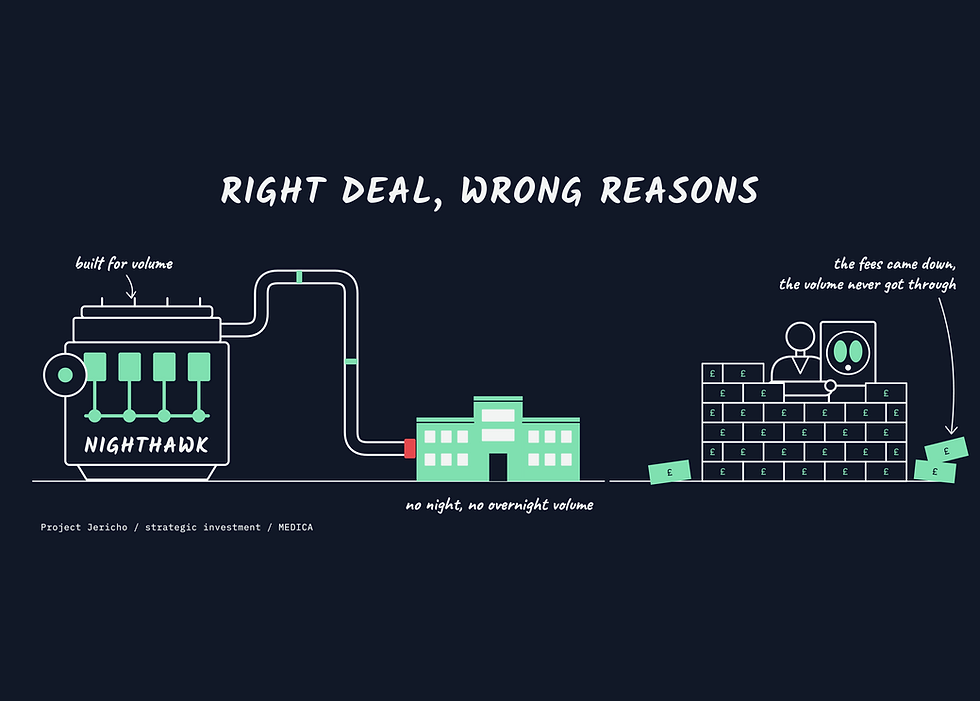
It took a while to get the third and fourth customer. As we reached around ten, a decade after we launched, NICE published its major trauma guideline, NG39, which put CT imaging at the centre of how major trauma is assessed.
Nighthawk volumes exploded.
A change in guidance had multiplied demand for exactly the capability we had spent years building. There was no scramble, because the infrastructure, the radiologist network and the transfer protocol already existed.
You cannot time regulation. I have a few scars on that one. But you can make sure that when it moves in your direction, you are the one organisation already holding the thing it requires. We only had to scale.
Nighthawk was the profit engine and chest x-ray was not, because of scale
Scale is the whole distinction between the two products.
Chest x-ray reporting was linear. Low unit value, the job that got left until last, a very visible problem a hospital had to fix. Twice the volume needed twice the radiologist hours. I had no structural advantage over anybody else who could hire radiologists.
What I had was a better price and a promise to report inside forty-eight hours using UK radiologists.
Nighthawk had different economics on both sides at once. The unit economics worked for my radiologist. The hospital team got to sleep.
I once met a surgeon who had retrained as a radiologist, partly because my service was installed at her hospital. She could not face the nights as a surgeon. She had worked out that as a radiologist, she could sleep.
That is the sort of thing that tells you what you have built.
Every hospital added improved the economics of a radiologist's night. Better economics attracted more radiologists. Better coverage made the service more attractive to the next hospital. It compounded from both ends, which is why it was still the most profitable part of the business long after I had stopped running it.
Revenue is what you sell. Network effect profits compound.
Most founders look for their profit engine by asking which product carries the highest margin today. The better question is which product gets cheaper to deliver, more valuable to the customer, every time somebody new joins. That is a network effect.
Elon Musk love or hate him has done this at SpaceX, cheaper payload per kg = more payloads * number of rockets = a trillion.
Listen for the fact of life and question them
Network effects are found rather than designed. Everybody knows the Mark Zuckerberg version.
Fewer people notice that the same mechanism is sitting inside an unglamorous service business, waiting for somebody to connect two customers who each thought their problem was theirs alone.
It usually takes a different way of looking at the same room to see it.
Three takeaways.
Keep selling the product that gets you through the door.
Once you are inside, listen for the problem that is not on your service list, particularly the one your customer describes as a fact of life rather than as a requirement. Facts of life are usually unsolved problems.
Then ask whether the same problem is unsolvable at another customer too, then be prepared to burn the midnight oil to find out.
Sometimes the formula to that physics equation is staring you in the face. Sometimes it is not physics at all, just a person at the console hitting SEND the way they always have.
Next: Part 7.
Author: Simon Rasalingham, 2026
How to Build a Start-up: the full series
Part 6: When the Rules Change, Sometimes You Are Sitting on a Network Effect (you are here)


Comments