Why Customers Matter More Than the 7 Percent Club

Updated: 7 days ago
How to Build a Start-up, Part 1, Author: Simon Rasalingham, 2026
I won my first tender in a meeting room at Whipps Cross University Hospital. It came down to one question about costs.
I was down to the last two.
They told me the other supplier had said that integrating with the hospital's local radiology system would cost £50,000. They asked how I planned to do it. If my cost was the same, then the two bids were the same, and they had more pedigree. I was just an idea and a start-up.
I had my notebook in front of me and was scribbling a bit. Then I said out loud, "There must be a cheaper solution. I can't believe it would cost that much. It makes the whole project not worth doing for you."
Bang! It came out of nowhere. Years earlier, at Guinness, I had learned how to virtually control a screen and reach an internal network securely. It is called remote desktop.
It was free, because the hospital had already bought it.
I won the contract. It was signed a week later. My first customer.
Free hides the exchange
With enough capital, you can give a product away. Free removes friction, it can build data, habit and market power. If I had been backed by a mega round, I could easily have offered it free and won the business there and then.
But with no capital to do that, I created a solution that was good for the customer and good for our radiologists. They got secure access to the clinical history, so they could make a better report than the other provider.
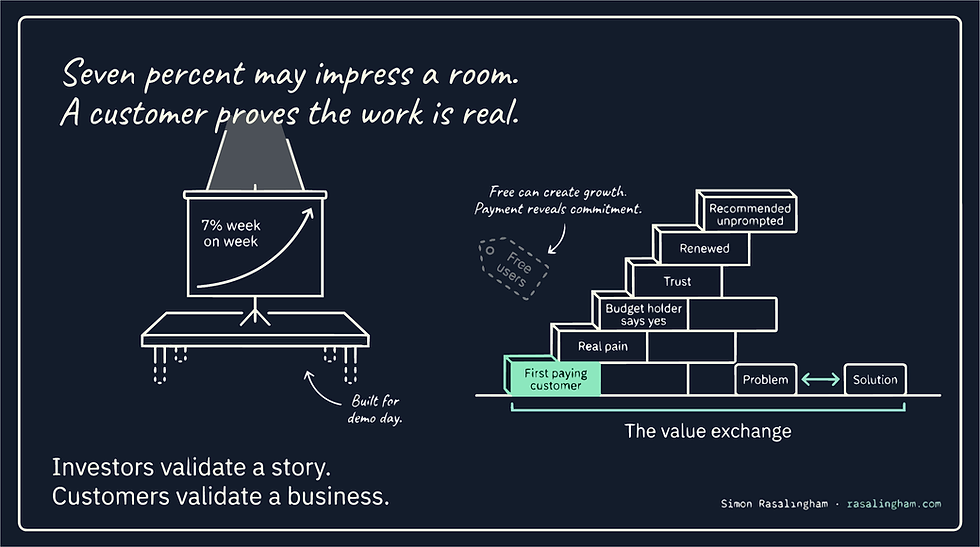
If you have the capital, giving your product away can create growth, but you could miss a vital part of the process that makes your service unique and cost competitive.
The 7% club
Seven percent is a strange number. To a finance person, it is roughly the annual return that doubles your money in ten years. To a founder, it is close to the weekly growth rate that makes investors lean forward. And for many, it is about the odds of ever raising venture capital.
Less, if you do not look like the founders who usually get funded.
I have built four healthcare companies and never lived inside any of those sevens. They still helped save thousands of lives.
For the 93% outside the club standing behind the luxury red rope, it is brutal, and it gets personal. No metric is worth a life, a family or a mind pushed past repair.
A business should demand courage. That is why, more often than not, you do not need to be part of the 7% club. You just need your first signed customer.
A signed contract is a signal
Something changes with the first one. Not a grant, a prize or a pitch-competition cheque. A customer.
The contract value may be small, but the paperwork is not, especially with the NHS Standard Terms and Conditions.
But it is more important than the 7% club.
Venture capital is not the enemy. A good investor helps you move faster, hire better and survive the long middle.
But it brings pressure and expectations that perhaps you do not want, and that may well distract you. The next round must be bigger, the story sharper, the exit worth the risk.
Trust compounds slowly, through delivery, honesty and consistency. Nobody wants a system that works in the demo and fails on the ward.
The best customers show you exactly where the process is breaking. If you listen, they are helping you improve your product.
Quiet founders have an edge
Customer work means meetings, follow-ups, rejection, and knowing that the competition is more established or better funded than you. It can feel harder if you do not fit the loud, polished founder stereotype. That stereotype does not work in healthcare, trust me.
But listening is a skill. So is pattern recognition. So is noticing friction and asking precise questions.
Founders who see systems differently, have little appetite for shallow social-media skills or judgment on value based on 'likes'. Building lasting customer relationships have an edge.
Three takeaways:
(1) Win a customer who pays.
(2) Find out what saying yes costs them and reduce it anyway you can. The real objection is rarely on your list.
(3) Take funding as fuel once the customer base exists.
Getting into the club is impressive, a conversation in a server can give you the confidence to get that paying customer, that is the real percetage in business.
Next: Part 2, Why Different Thinkers Build Great Businesses


Comments