EU MDR, FDA or UKCA: Where should a British SME start?

Updated: 21 hours ago

Author: Simon Rasalingham, 2026
On my first visit to the FDA, driving up to the entrance, I wondered why there were men with semi-automatic weapons at the gate. Then I took my shoes off to get through security, to attend a meeting about clearing an algorithm.
The meeting was my team on one side and two rows of FDA people on the other. For a first meeting.
That is where most British founders' regulatory strategy gets decided. It is very intimidating, and it can put you off for life. I still think the FDA is the best place to start.
Are you building one evidence package, or three?
The device is the same. The clinical performance is the same. The risk profile is the same.
The FDA wants it in its format, on its terms, against its expectations it's ground truth. The EU wants it again for MDR, through a notified body, with its own clinical evaluation requirements. Great Britain has wanted it a third time.
Three packages. One product.
For a large manufacturer that is a workstream and a budget line. It absorbs parallel submissions and country-by-country friction as a cost of doing business.
For a small company it is runway. It is the months or years you are not selling. It is also the moment you decide to focus one market and drop the another — not because the second market is wrong, but because the duplication costs too much money.
And that duplication does not make a single patient safer.
The UK has named that problem, and drafted a fix
This is the part most founders have missed, because it happened quietly and before the headlines.
On 8 May 2026 the UK notified the World Trade Organization of the draft Medical Devices (Amendment) Regulations 2026 — 102 pages amending the 2002 Regulations for Great Britain. The stated rationale includes "facilitating access to medical devices by minimising unnecessary duplication through the introduction of international reliance routes."
Duplication named as the problem. Reliance named as the fix. In the government's own words, seven months before the National Commission recommended the same thing.
The instrument also comes with dates, which is what a founder actually needs: proposed adoption December 2026, proposed entry into force June 2027.
Now the part that decides your strategy.
Reliance, as drafted, runs in one direction only. A device authorised by a designated comparator regulator can reach the Great Britain market without UKCA marking. My research on those comparators are the US FDA, Health Canada and Australia's TGA. Nothing in the scheme gives a UKCA-marked device access to those markets in return.
The MHRA and FDA announced a formal collaboration in October 2025 and deepened it in April 2026, but that is cooperation, not mutual recognition, and cooperation does not put a product on a shelf.
So reliance is an import licence for other regulators' decisions. It is not an export licence for ours.
And the EU is not among the designated comparators.
Work it through and it is stark.
If you start with UKCA you open Great Britain. Nothing else. Your approval does not travel.
Start with the FDA and you open the United States, and then Great Britain through reliance, without building a second package.
A UKCA is honoured at home and nowhere else — valid, respected, and with no international regulatory stamps to collect. An FDA authorisation, as drafted, is a passport that gets you through the British border as well.
Nor is reliance the only door. CE-marked devices can already be placed on the GB market until 30 June 2028 for older MDD and AIMDD certificates, and until 30 June 2030 for EU MDR and IVDR. In February 2026 the MHRA went further and consulted on recognising CE marking in Great Britain indefinitely.
Which produces an uncomfortable conclusion. Two doors into Great Britain are being widened at once — reliance opening from Washington, Ottawa and Canberra, and CE recognition opening from Brussels. Neither is a door out for a British manufacturer holding a UKCA mark. They still faces the full package everywhere else. Which settles the question in the title. If you are asking whether to go to the FDA, you have already decided your UKCA strategy — because you intend to sell beyond Great Britain, going FDA first makes more commercial sense but at higher costs.
The founders for whose market is only Great Britian UKCA is the answer.
If your plans are international the choice is EU MDR or FDA.
There is the sting for domestic UK manufacturers who wish to expand overseas. The better reliance works, the easier it becomes for FDA products to enter Great Britain — while British products still face the full FDA package to go the other way.
Brussels has cut the cost of one of the three evidence packages
On 16 December 2025 the European Commission published COM(2025) 1023, amending the Medical Devices and IVD Regulations. The headline is €3 billion a year in reduced burden: fee reductions mandated for micro and small manufacturers, priority and rolling review for breakthrough and orphan devices, regulatory sandboxes, and software devices reclassified into lower risk classes. The justification is explicit — 38,000 medtech companies in Europe, 90% of them SMEs.
Two provisions matter more than the headline. The proposal moves the Medical Devices and IVD Regulations from Section A to Section B of Annex I of the EU AI Act, because applying both in parallel "could lead to overlaps of requirements and stifle innovation."
The EU looked at double-regulating medical AI and decided not to. And, less noticed, it promotes participation in IMDRF and the Medical Device Single Audit Programme, which is one audit accepted by several regulators.
But it remains a proposal. EU Parliament and Council will take years. What to watch in December
Three questions decide whether any of this changes my advice.
Does international reliance survive into the instrument adopted in December 2026, with the commencement dates intact?
Does the comparator list stay at the United States, Canada and Australia, or does the EU get added? For most British SMEs that is the nearest market and nearly equivalent to US in size, on our doorstep.
Does UK government put a mandate behind British SMEs and sovereign AI in healthcare?
Whilst those questions get answered I would still recommend generating your evidence in the UK, which remains an excellent place to do it. Watch COM(2025) 1023 through EU Parliament and Council. If your plans are overseas then
Start with the FDA, until there is a mandate behind British SMEs
Cost is why British founders have always shied away from going to the FDA first. It is the most expensive package to prepare and the most demanding to defend. That reputation is deserved, and so is the intimidation. A good part of the barrier is psychological, and it stays that way until you have done it once.
However, I still recommend going there first, and the market-access arithmetic is easy to understand if your plans are international.
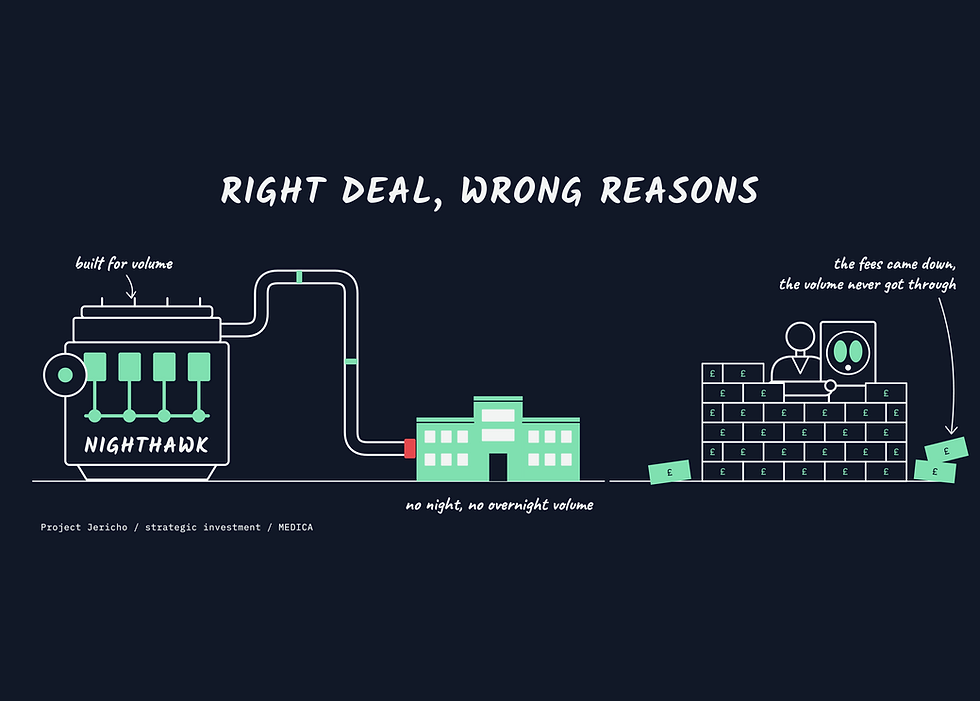
It does not make commercial sense for a British SME to build their products in the UK market, while better-funded overseas suppliers generate their evidence in their own market and then enter the UK better funded.
Sovereign support for British SMEs is the only way the calculus changes. Without a local Sovereign AI mandate, the FDA package buys you what the other options cannot. A larger market. More customers with the authority to purchase. Great Britain thrown in, if reliance lands as drafted. And, when things do not go according to plan, more room to pivot.
That last point is the one founders underrate. Plans changes. The product finds a different use, the first customer segment turns out to be wrong, the clinical claim narrows. When that happens in a small market with no clear payment route and no sovereign mandate behind you, you are out of options. When it happens in the US, you still have somewhere to turn.
So the higher cost is not only a cost. It is optionality, bought early, while you still have the choice. If Great Britain is genuinely your whole market, UKCA is the right answer and none of this applies to you. For everyone else, the choice is EU MDR or FDA — and I would take the pain with FDA first.
There is one part of the United Kingdom from which a British company reaches the European market as an insider — and it is not Manchester. That's for next post!
Sources: G/TBT/N/GBR/120, notified 8 May 2026, The Medical Devices (Amendment) Regulations 2026. COM(2025) 1023 final, CELEX 52025PC1023. Comparator designations and commencement dates are drawn from published analyses of the draft; verify against the instrument before relying on them. Author: Simon Rasalingham, 2026
How to Build a Start-up: the full series
More on British SMEs and regulation


Comments