Your 1990s Desktop Still Beats a Quantum Computer. That's Not the Story.

Updated: 7 days ago
Author: Simon Rasalingham, 2026
A new benchmark paper gives us, for the first time, a single number to compare quantum computers across platforms. The number is not flattering — and the reason it isn't flattering is more interesting than the number.
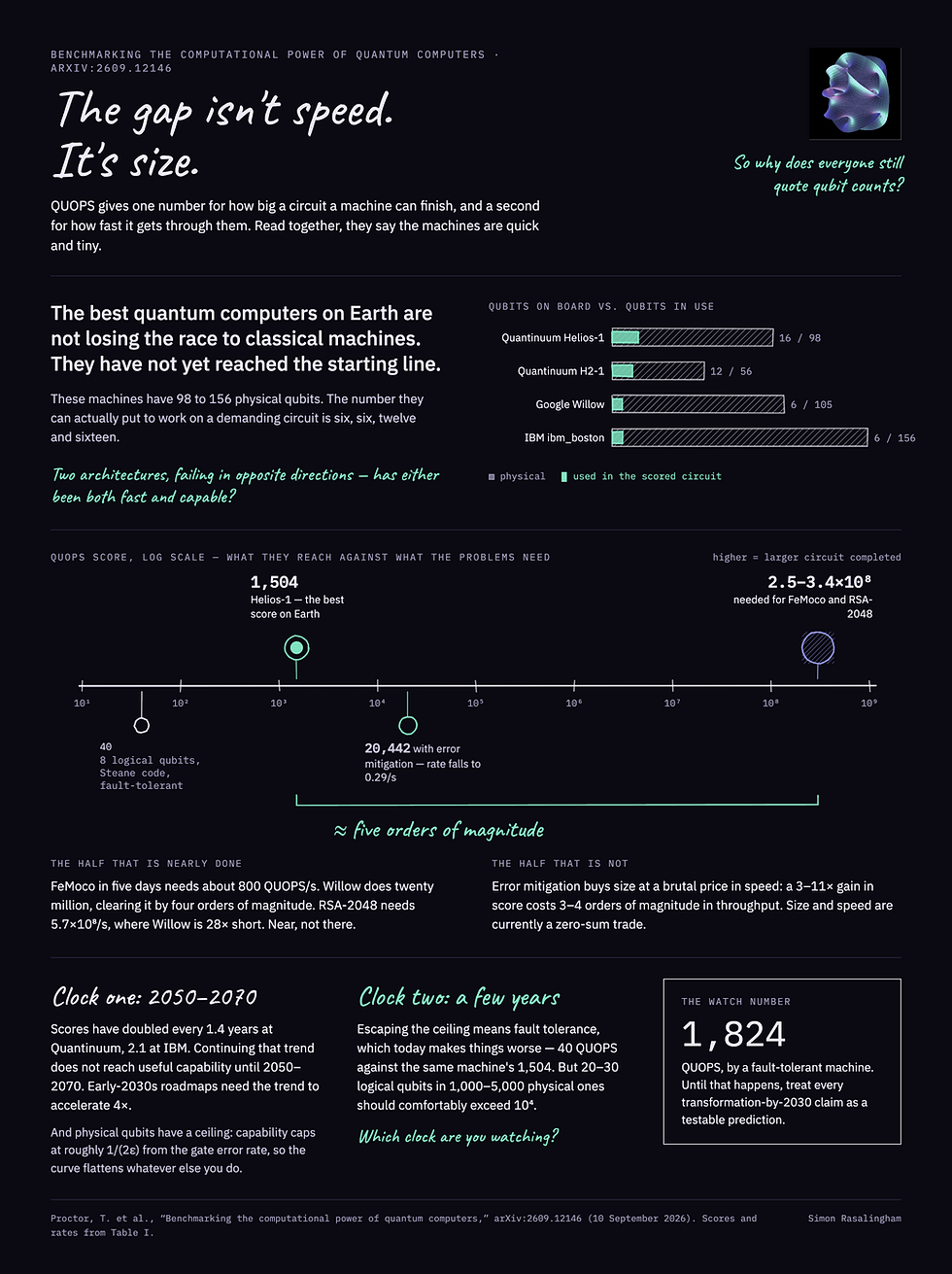
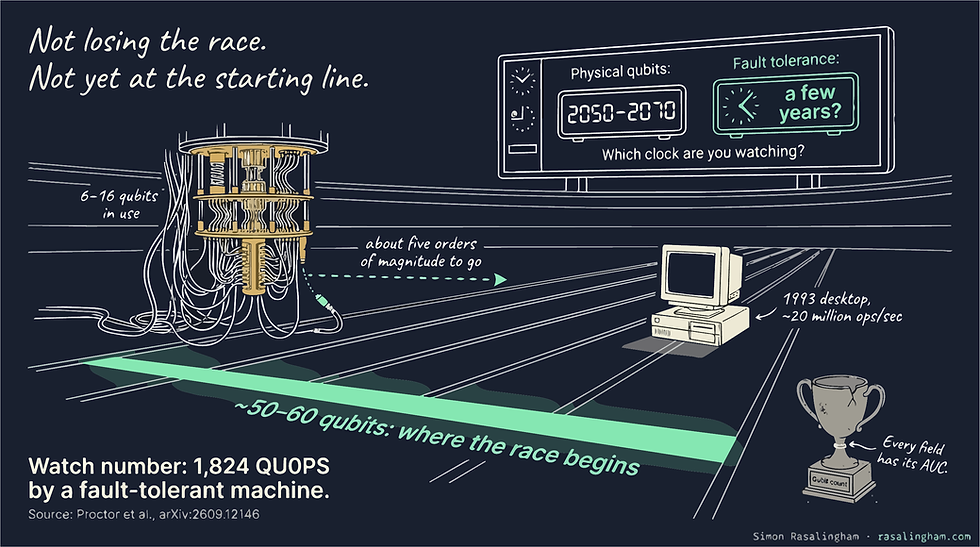
The headline finding, stated plainly: the best quantum computers on Earth are not losing the race to classical machines. They have not yet reached the starting line. Everything below is the evidence for that, and what it should do to your reading of any 2030 roadmap.
Last week a team from Sandia National Laboratories, Quantinuum, NVIDIA and the University of New Mexico published Benchmarking the computational power of quantum computers. They proposed a metric called QUOPS and ran it on four of the most advanced processors available: Google's Willow, IBM's ibm_boston, and Quantinuum's H2-1 and Helios-1.
The problem they're solving
Everyone quotes qubit counts. Qubit counts are close to meaningless. A 156-qubit chip with noisy gates can be less capable than a 56-qubit machine with clean ones, and there has been no honest way to line up a trapped-ion machine against a superconducting one — let alone against what a genuinely useful computation would demand.
QUOPS answers two questions at once. How big a circuit can the machine complete before noise destroys the answer — the QUOPS score. And how fast does it get through them — the QUOPS rate. Both matter. A machine that is accurate but glacial is a lab curiosity. One that is fast but wrong is a random number generator.
The results
Machine | QUOPS score | QUOPS/s | Qubits used | Physical qubits |
Quantinuum Helios-1 | 1,504 | 303 | 16 | 98 |
Quantinuum H2-1 | 1,320 | 353 | 12 | 56 |
Google Willow | 216 | 2.0×10⁷ | 6 | 105 |
IBM ibm_boston | 204 | 3.1×10⁵ | 6 | 156 |
Note columns four and five. These machines have between 98 and 156 physical qubits. The number they can actually put to work on a demanding circuit is six, six, twelve and sixteen.
Note also that the two architectures fail in opposite directions. The trapped-ion machines are patient and capable — Helios-1 completes a 1,504-gate circuit — but slow, at 303 operations per second. The superconducting machines are fast, Willow at twenty million operations per second, and run out of room almost immediately.
Neither has been both.
Translating that into something familiar
Simulating a quantum computer on an ordinary one costs roughly double per qubit. Sixteen qubits means tracking 65,536 numbers, and every gate updates all of them. So a rough classical-equivalent throughput is the QUOPS rate multiplied by 2ⁿ.
The paper does not make this comparison. I will make it, with the working shown at the end so you can check me.
Helios-1: 303 × 2¹⁶ ≈ 20 million operations per second. A 1993 desktop PC.
Willow: 2.0×10⁷ × 2⁶ ≈ 1.3 billion. A 2002 office desktop. IBM's ibm_boston lands near Helios-1, at 20 million, by a different route.
The most advanced error-corrected demonstration in the paper — up to eight logical qubits in a Steane code, running fault-tolerantly — scores 40 QUOPS at 4.9 QUOPS/s on width four. Classical equivalent: 78 operations per second. The Apollo Guidance Computer managed roughly five hundred times that.
A modern laptop does not merely match Helios-1's best circuit. It finishes it in under a millisecond while Helios-1 takes five seconds.
Why this isn't the obituary it reads like
The cost of simulating a quantum computer doubles with every qubit. At 16 qubits, trivial. At 50, you need a supercomputer. At 60, nobody on Earth can do it. The entire contest is decided by qubit count, and these machines have not reached the count where the contest begins.
And the speed problem is close to solved. Simulating the FeMoco molecule in five days needs about 800 QUOPS/s. Willow does twenty million — it clears that by four orders of magnitude. Breaking RSA-2048 in five days needs 5.7×10⁸ QUOPS/s, where Willow is 28× short. Near, not there. In the paper's words, today's physical-qubit processors "have (or nearly have) the necessary QUOPS rate."
Where they fall down is size. The QUOPS targets for those two problems are 2.5×10⁸ and 3.4×10⁸. The best machine on Earth scores 1,504.
The authors put the shortfall at "roughly five orders of magnitude."
The dial nobody is reporting
There is one result in this paper that deserves more attention than it will get. Error mitigation — running the circuit many times and correcting statistically — buys you a bigger circuit at a brutal price in speed.
Helios-1 goes from 1,504 QUOPS to 20,442 with error mitigation. Its rate collapses from 303 per second to 0.29. Across all four machines, a 3–11× gain in score costs three to four orders of magnitude in throughput.
That is not a footnote. It means size and speed are currently a zero-sum trade, and every impressive demonstration you read about should prompt one question: at what rate? A machine that can run a big circuit once a week is not a computer.
The number nobody will put in a press release
These machines have been doubling in QUOPS score every 1.4 years at Quantinuum and every 2.1 years at IBM. The authors extend their own trend lines and conclude that continuing the observed growth would not reach the capability required for useful challenge problems until "2050–2070."
Roadmaps promising scientifically transformative capability in the early 2030s require that trend to accelerate by a factor of four. That is the authors' figure, not mine.
Worse, physical qubits have a ceiling. Capability caps at roughly 1/(2ε) from the gate error rate, so the curve flattens whatever else you do. Escaping means fault tolerance. And on this benchmark, fault tolerance still makes things worse: Helios-1's error-corrected mode scores 40 QUOPS against the same machine's 1,504 running raw.
Update, 20 October 2026: Quantinuum has since shown error-corrected logic gates on Helios-1 that are about 13 times more accurate than the same machine's raw gates. On the QUOPS benchmark, fault tolerance still loses. At the level of a single gate, it no longer does. I cover what that changes in a follow-up post.
Two clocks, telling different times
The first time a fault-tolerant architecture beats every physical-qubit architecture on this scale will be a major milestone the field has yet to reach — a realisation of Gottesman's criterion. The authors think it could happen soon. Their projections suggest "20–30 logical qubits encoded in 1,000–5,000 physical qubits" should comfortably exceed 10⁴ QUOPS, and recent advances in error correction are lowering that cost fast.
So there are two clocks running. The physical-qubit clock says 2050 to 2070. The fault-tolerance clock could turn over in a few years.
Everything depends on which one you are watching.
I have seen this film before
I should declare an interest, because I have run this experiment in another field.
The number everyone quoted was AUC — a single measure of how well a model separates disease from not-disease on a test set. Papers competed on it. Funding followed it. It was easy to publish and almost entirely orthogonal to whether the thing worked in a hospital.
We had three years of real-world NHS evidence. It still did not win national deployment.
What decided national deployment was who carried the liability when the algorithm made a mistake. And which competitors were better funded.
Qubit count is quantum computing's AUC. Every field invents a number that is easy to report and orthogonal to whether the thing works, then optimises for it for a decade. QUOPS is an attempt to stop that happening here, which is why it matters more than its unflattering results suggest.
The second lesson is less comfortable. When medical AI's real bottleneck was finally named, the timeline did not compress. It extended. The honest benchmark made the problem look harder, and the field was better for it.
Expect the same here.
What this means for what I'm building
I run a company whose stated ambition includes quantum technologies applied to biotechnology. I have just relayed an argument that useful quantum computation is roughly twenty-five to forty-five years away. Those two things need reconciling, so let me do it directly rather than leave it hanging.
I am not building on an assumption that fault-tolerant quantum hardware arrives this decade. Nothing I am working on requires it.
The near-term value at this intersection is not quantum computers running biological simulations. On this evidence that is a 2050 proposition. It is the formalism: quantum-derived mathematical structures, of the kind Bob Coecke's diagrammatic work makes tractable, applied to interpretability in classical models running on classical hardware, today. That is a claim about representation, not about qubits, and it depends on no hardware roadmap at all.
What would change my mind: a fault-tolerant architecture setting a QUOPS record, combined with a sustained doubling time under twelve months. The authors think the first could arrive quickly. If both hold for three consecutive years, the 2050 floor is wrong and I will say so here.
What to actually take from this
The authors put it better than I can. The path to useful quantum computing will be expensive, "creating strong incentives for hype and placing a premium on objective analysis."
That is what QUOPS is for. Not to embarrass anyone — the people who built these machines built something genuinely remarkable — but to give everyone outside the field one honest number to watch.
Watch for a fault-tolerant machine beating 1,824 QUOPS.
Until that happens, treat every transformation-by-2030 claim as a testable prediction. Because now it is one.
Source and method
Proctor, T. et al., "Benchmarking the computational power of quantum computers," arXiv:2609.12146 (10 September 2026). Scores and rates are from Table I.
Classical-equivalence figures are my own and not the paper's. Method: classically simulating an n-qubit circuit requires updating 2ⁿ complex amplitudes per gate, so classical-equivalent throughput ≈ QUOPS rate × 2ⁿ.
Helios-1: 303 × 2¹⁶ ≈ 2.0×10⁷
Willow: 2.0×10⁷ × 2⁶ ≈ 1.3×10⁹
Steane-code processor: 4.9 × 2⁴ ≈ 78
These figures ignore sparsity and tensor-network methods, which make real classical simulation cheaper — so they are upper bounds on the quantum machines' relative standing, and the comparison flatters them. Corrections welcome. Author: Simon Rasalingham, 2026 How to Build a Start-up: the full series


Comments